

The District Court of Appeal of the State of Florida, Fourth District, recently reversed summary judgment in favor of a mortgagee, holding that a genuine issue of material fact as to whether the original plaintiff or the substituted successor in interest held the note when the complaint was filed precluded summary judgment, and thus that the borrower’s lack of standing defense was not refuted. A copy of the opinion in Craven-Lazarus v. Pennymac Holdings, LLC is available at: Link to Opinion. A mortgagee sued to foreclose its mortgage. The complaint alleged that it was “entitled to enforce the Note as a…
Posts published in “Mortgage Banking Foreclosure Law”
Mortgage Banking Foreclosure Law

The Supreme Court of Ohio recently held that, when debt on promissory note secured by mortgage has been discharged in bankruptcy, the holder of the note may not pursue collection against the maker of note, but the mortgagee has standing to foreclose on the collateral property, and can use the amounts due on the note as evidence to establish that it may collect from the forced sale of the property. The Court also held that, regardless of whether the creditor can obtain a personal judgment on the note against the borrowers, the creditor must still prove that it is the…

The U.S. District Court for the Middle District of Georgia recently held that when a mortgagee makes some affirmative misrepresentation or action that renders a foreclosure sale unfair, a claim for wrongful foreclosure may stand independently of a claim for fraud. The Court also held that the statute of limitations on a claim under a security deed is 21 years, if the security deed is a sealed instrument under Georgia law. A copy of the opinion in Malone v. Federal Home Loan Mortgage Corporation is available at: Link to Opinion. On Aug. 26, 2007, in connection with a refinance mortgage…

The Appellate Court of Illinois, Second District, recently held that a foreclosure judgment was void, where the foreclosing first mortgagee did not properly name a second mortgagee in its summons. A copy of the opinion in U.S. Bank National Association v. Johnston is available at: Link to Opinion. In 1997, the defendant borrowers executed a mortgage and note against their rental property. The mortgage conveyed a lien interest in the property as security for the note to the first mortgagee. This first mortgage was recorded. On Jan. 28, 2005, the defendant-borrowers executed a second mortgage and note against the property. The…

The U.S. Court of Appeals for the Seventh Circuit recently held that as a matter of federal procedural law, a judgment of foreclosure is not a final and appealable judgment, even if state foreclosure law might provide otherwise. Here, the Court held that a Wisconsin judgment of foreclosure was not final and appealable when obtained in a federal district court, even though Wisconsin law treats a foreclosure judgment ordering a sale as final and appealable. A copy of the opinion in Bank of America, N.A. v. Martinson is available at: Link to Opinion. A mortgagee filed suit to foreclose a residential…

The U.S. Court of Appeals for the First Circuit recently held that the cancellation of a foreclosure sale prohibits a borrower from obtaining a permanent injunction to bar a foreclosure, as they would not suffer irreparable harm. A copy of the opinion in Frangos v. Bank of America, N.A. is available at: Link to Opinion. In 2005, the plaintiff borrowers obtained a refinance mortgage loan on their home. The borrowers defaulted on their mortgage in 2007 and again in 2009. The loan was modified but the borrowers still had not made a mortgage payment since 2009. Between 2011 and 2013,…

The District Court of Appeal of Florida, Second District, recently reversed a final judgment of foreclosure, instead directing the trial court to enter judgment in favor of the borrower. In so ruling, the Appellate Court rejected and disregarded the current servicer’s evidence that the loan modification documents had not been received, because the borrowers introduced evidence that they had returned their signed loan modification agreement materials to the prior servicer, the prior servicer received the materials, and the prior servicer accepted the modified payments. With this evidence, the Appellate Court held that the loan had been modified. A copy of…

The Court of Appeals of California, Fourth District, recently held that a homeowner who has been foreclosed on by one with no right to do so — by those allegations alone — sustains prejudice or harm sufficient to constitute a cause of action for wrongful foreclosure. Citing Glaski v. Bank of America (2013) 218 Cal.App.4th 1079, the Appellate Court also held that, because the plaintiff properly alleged the foreclosure was void and not merely voidable, tender was not required to state a cause of action for quiet title or for cancellation of instruments. A copy of the opinion in Sciarratta v.…

In an appeal that garnered significant attention from consumer groups who filed briefs as amici curiae, the Supreme Court of Pennsylvania recently held that any entity that charges excessive attorney’s fees in connection with a foreclosure may be liable for treble damages, fines, and attorney’s fees under the Pennsylvania Loan Interest Protection Law. A copy of the opinion in Glover v. Udren Law Offices, PC is available at: Link to Opinion. The borrower entered into a residential mortgage in 2002, and later defaulted. In the foreclosure proceedings that followed, the mortgagee’s counsel took several actions on the mortgagee’s behalf. The parties…
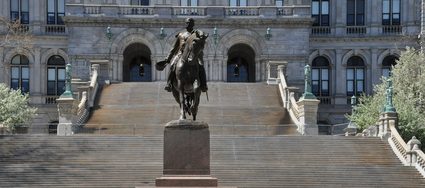
On June 23, New York Gov. Andrew Cuomo signed S8159 into law, which among other things contains provisions relating to: Mandatory settlement conferences in residential foreclosures. The new law modifies New York’s mandatory settlement conference provisions for residential mortgage foreclosures to among other things allow courts to sanction mortgagees up to $25,000 and award attorney fees in favor of the borrower for non-compliance, clarifies that the failure to offer or accept an offer is not sufficient to establish lack of good faith participation, and allows borrowers who participate in settlement conferences to have defaults vacated. A pre-foreclosure duty for mortgagees to…
In a putative class action alleging failure to timely record satisfactions of mortgages, the Supreme Court of Ohio recently held that a cease-and-desist order issued by the Federal Housing Finance Agency (FHFA) to Federal National Mortgage Association (Fannie Mae) did not preclude the trial court from exercising jurisdiction under the federal statute governing judicial review of FHFA orders. However, the Court also held that a different federal law bars the trial court from ordering Fannie Mae to provide monetary relief under the Ohio statute at issue, while Fannie Mae is under FHFA’s conservatorship, because the federal statute prohibits Fannie Mae…
The U.S. District Court for the Eastern District of New York recently held that a confirmable Chapter 13 plan cannot both “vest” title to real property and “surrender” that property to a secured lender, and that the secured lender may refuse to accept the vesting in satisfaction of its claim. Thus, the Court held that a debtor may not force the transfer of title in collateral to a secured creditor in satisfaction of the secured creditor’s claim, without the consent of the secured creditor. A copy of the opinion in HSBC Bank USA, NA v. Zair is available at: Link to…