
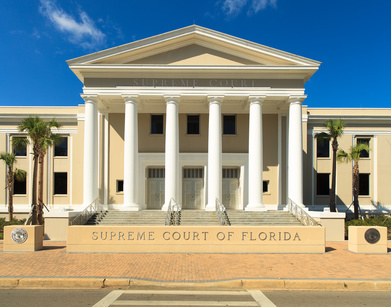
Reversing a ruling by the Fourth District Court of Appeal, the Supreme Court of Florida recently held that a mortgagee’s voluntary dismissal of an appeal made the borrower the prevailing party entitled to recover appellate attorney’s fees because the mortgagee maintained its right to enforce the mortgage contract that contained a prevailing party attorney’s fees provision until it dismissed the appeal. A copy of the opinion in Glass v. Nationstar Mortgage, LLC is available at: Link to Opinion. A mortgagee filed an in rem foreclosure action on a reverse mortgage on real property. The borrower moved to dismiss the complaint for…
Posts tagged as “Mortgage Law”

The U.S. Court of Appeals for the Fifth Circuit held that ambiguity in the deed of trust regarding the lender’s right to pay real estate taxes and establish an escrow account precluded entry of summary judgment in favor of the loan servicer on the borrower’s breach of contract claim. Additionally, the Court vacated a counterclaim for foreclosure in favor of the loan servicer and remanded the claim for reconsideration, noting that foreclosure would only be available if the servicer could show that it complied with contractual requirements. Finally, the Fifth Circuit affirmed the trial court’s rulings in favor of the…

The Supreme Court of Ohio recently held that a mortgagee may enforce a mortgage against a mortgagor who signed, initialed, and acknowledged the mortgage even though the body of the mortgage agreement does not identify the mortgagor by name. In so ruling, the Supreme Court of Ohio allowed a mortgagee to use parole evidence to determine the mortgage signatory’s intent where there is an ambiguity. A copy of the decision in Bank of New York Mellon v. Rhiel is available at: Link to Opinion. A bank issued a mortgage loan to husband and wife borrowers. Only the husband executed the note. Both…

The U.S. Court of Appeals for the Eleventh Circuit recently held that a mortgage loan with a post-plan maturity date was not discharged in a Chapter 13 bankruptcy because the plan did not “provide for” the debt and modify the repayment terms of the mortgage. The Eleventh Circuit also held that the debt was not discharged because discharge would violate 11 U.S.C. § 1322(b)(2)’s anti-modification provision for mortgages secured by the debtor’s principal residence. A copy of the opinion in Mildred M. Dukes v. Suncoast Credit Union is available at: Link to Opinion. The debtor had two mortgage loans on her…

In a 2-1 decision, the U.S. Court of Appeals for the Sixth Circuit recently held that, because a complaint’s sole federal claim under the Garn-St. Germain Depository Institutions Act of 1982 did not provide a private cause of action, and because the state law claims did not implicate significant federal issues, the trial court lacked jurisdiction. Accordingly, the Sixth Circuit vacated the trial court’s judgment with instructions to remand the case to state court. A copy of the opinion in Estate of Cornell v. Bayview Loan Servicing, LLC is available at: Link to Opinion. The borrower died with an outstanding…

The Appellate Court of Illinois, First District, held that a borrower’s petition to vacate a final foreclosure order based on allegedly improper service filed six months after the borrower first participated in the foreclosure action was time-barred under the Illinois Mortgage Foreclosure Law. Accordingly, the Appellate Court affirmed the ruling of the trial court dismissing the borrower’s petition. A copy of the opinion in Wells Fargo Bank v. Roundtree is available at: Link to Opinion. In September 2015, the plaintiff mortgagee instituted a foreclosure action against the defendant borrower after she defaulted on her mortgage loan. The mortgagee served the…

The U.S. Court of Appeals for the Seventh Circuit held that the plaintiffs failed to prove a violation of the federal Equal Credit Opportunity Act (ECOA) under a disparate treatment theory where their only evidence was a vague statement from one of the defendant’s employees. Accordingly, the Seventh Circuit affirmed the ruling of the trial court granting summary judgment in favor of the defendant. A copy of the opinion in Mario Sims v. New Penn Financial LLC is available at: Link to Opinion. The plaintiffs, an African-American couple, purchased a home from the seller in October 2008 for $185,000. The plaintiffs…

The U.S. Court of Appeals for the Eleventh Circuit held that 12 U.S.C. § 1715z-20(j) did not alter or limit the lender’s right to foreclose under the terms of the valid reverse mortgage contract where the non-borrower spouse was still living in the home. Accordingly, the Eleventh Circuit affirmed the trial court’s dismissal of the plaintiff’s petition for injunctive relief to prevent the foreclosure sale. A copy of the opinion in The Estate of Caldwell Jones, Jr. v. Live Well Financial, Inc. is available at: Link to Opinion. A borrower obtained a reverse mortgage that was subsequently assigned to the defendant…

The U.S. Court of Appeals for the Eleventh Circuit recently held that the reporting of a mortgage account as past due and delinquent during a forbearance plan was neither inaccurate nor materially misleading under the federal Fair Credit Reporting Act (FCRA), 15 U.S.C. § 1681, et seq. A copy of the opinion in Felts v. Wells Fargo Bank, N.A. is available at: Link to Opinion. The plaintiff borrower lost her job and enrolled in an unemployment forbearance plan with her mortgage loan servicer. The forbearance plan called for “monthly forbearance plan payments” of $25 for a period of six months. The…

The U.S. Bankruptcy Appellate Panel for the Eighth Circuit recently applied the “conceivable effect” test in holding that a bankruptcy court lacked jurisdiction over a state law fraud claim raised by a third party regarding the validity of a lender’s lien, and therefore, declined to consider the issue on appeal. In so ruling, the Panel ruled that the state law fraud claim did not invoke “arising under” or “arising in” jurisdiction of the bankruptcy court because the state law fraud claim was not created or determined by the Bankruptcy Code, and could exist outside of bankruptcy. A copy of the…

The U.S. Court of Appeals for the Fifth Circuit held that where a mortgagee rescinded a notice of intent to accelerate and then filed a foreclosure action without first issuing a new notice of intent to accelerate, it failed to meet its burden to show clear and unequivocal notice of intent to accelerate prior to filing suit, and therefore was not entitled to foreclosure judgment. Accordingly, the Fifth Circuit reversed the ruling of the trial court granting summary judgment in favor of the bank, and dismissed the foreclosure action. A copy of the opinion in Wilmington Trust, N.A. v. Angel…

The District of Columbia Court of Appeals recently held that a condominium association acting on its six-month super-priority lien for unpaid condominium assessments pursuant to § 42-1903.13(a)(2) of the District of Columbia Condominium Act (the “D.C. Condo Act”) may not conduct its foreclosure sale subject to a first deed of trust lien, even if the terms of sale stated that the condo unit would be sold subject to first deed of trust. A copy of the opinion in Liu v. US Bank National Association is available at: Link to Opinion. The borrower obtained a loan to finance his purchase of a condominium…